
Last Saturday, you likely spent four hours behind a high-pressure jet washer, yet those stubborn, ink-like marks didn’t budge. It’s a common frustration for UK homeowners who find that even the most powerful domestic equipment fails when they try to figure out how to remove black spots from patio surfaces. These marks aren’t just surface dirt. They are crustose lichen that has physically anchored into the pores of your stone over a period of two to three years, making them nearly impossible to shift with water alone.
We understand how disheartening it is to see expensive Indian Sandstone or limestone looking weathered and feeling dangerously slippery despite your hard work. You deserve a pristine outdoor space without the constant fear of damaging your stonework or mortar. This ultimate 2026 guide provides the professional methods we use at My Property Pros to eliminate lichen permanently. You’ll learn why traditional pressure washing often fails and how our SoftWash UK trained technicians use safe, controlled solutions and Smartseal protectors to restore your patio to a like-new finish that stays clean for the long term.
Key Takeaways
- Identify the true nature of stubborn “ink splatters” as black lichen (Lichen hiascens) and understand why the UK’s damp climate makes them so persistent.
- Learn how to remove black spots from patio surfaces using professional soft washing techniques rather than aggressive jet washing that can permanently etch your stonework.
- Discover why SoftWash UK-certified methods are the industry standard for safely killing biological organisms with solutions that are neutralized for family and pet safety.
- Understand how regional factors in cities like Nottingham or Bournemouth affect your property and why Smartseal professional-grade protection is the key to longevity.
- Find out how choosing NASW-certified experts can restore your property’s kerb appeal and provide a cost-effective alternative to expensive stone replacement.
What are the Black Spots on Your Patio? Understanding Black Lichen
If you have noticed dark, stubborn marks on your paving that resemble dried ink splatters, you are likely dealing with a complex biological growth. These aren’t simple dirt or oil stains; they are a hardy organism known as Lichen hiascens, or black lichen. Many homeowners find that their initial attempts at how to remove black spots from patio surfaces fail because they treat the issue as a surface-level cleaning problem rather than a biological infestation.
To better understand this concept, watch this helpful video:
The Biology of the “Ink Spot”
Black lichen is a symbiotic partnership between a fungus and an alga. The fungus provides the physical structure and protection, while the alga produces food through photosynthesis. To understand the complexity of these organisms, it is useful to research What is Black Lichen in a broader scientific context. These organisms arrive as microscopic airborne spores, often drifting from nearby trees or shrubs before settling on porous paving.
Once established, the lichen doesn’t just sit on the surface. It sends out “hyphae,” which are microscopic, root-like tendrils that tunnel deep into the pores of the stone. Black lichen is a biological coloniser that feeds on minerals in the stone. Because these roots are embedded so deeply, standard household detergents and vigorous scrubbing only remove the top layer, leaving the roots intact to regrow within weeks.
Why the UK Climate Accelerates Growth
The UK’s specific weather patterns create the ideal environment for lichen to thrive. Mild, wet winters in regions like Cornwall and Essex, or the high humidity found in coastal cities like Belfast and Cardiff, provide the consistent moisture these organisms crave. Certain materials are more susceptible than others. We frequently see heavy infestations on:
- Indian Sandstone: Highly porous and a primary target for spores.
- Limestone: Its mineral composition provides a rich “food” source for the lichen.
- Yorkstone: The textured surface traps moisture and spores easily.
Shade and poor drainage further contribute to the problem. If a patio stays damp for long periods due to north-facing positioning or overhanging foliage, the lichen can spread across the entire surface in a matter of months. Successfully learning how to remove black spots from patio areas requires professional-grade solutions. At My Property Pros, our technicians use softwash techniques and professional pressure washing equipment to ensure the biological bond is broken, eliminating the lichen at the root without damaging the stone’s integrity.
The Pressure Washing Myth: Why DIY Jet Washing Can Fail
Many homeowners believe that maximum pressure is the secret to success when researching how to remove black spots from patio surfaces. It’s a common misconception. Blasting stone with a high-PSI domestic jet washer often creates more problems than it solves. While the immediate results might look impressive, the aggressive force can permanently damage the substrate.
Instead of lifting the lichen, excessive pressure frequently “etches” the stone. This process strips away the surface layer and exposes the delicate minerals underneath. You’ll often see “striping” or “tiger stripes” across the paving where the narrow wand has moved unevenly. These marks are often permanent and can ruin the aesthetic of expensive Indian Sandstone or limestone. High-pressure wands also easily blow out pointing and jointing sand. This leaves gaps where water can settle, leading to loose slabs and frost damage during the winter months.
The “Pore” Problem
When you use too much force, you’re essentially sandblasting the stone. This opens up the natural pores, making the surface significantly more porous. Lichen thrives in these microscopic gaps. By increasing the surface area, you’re giving black spots a better grip to latch onto. This explains why many DIY attempts result in the lichen returning faster and thicker within just 6 to 12 months. Our professional pressure washing services use specific techniques to avoid this cycle of damage and keep your stone sealed.
Professional Rotary Cleaners vs. Domestic Wands
Domestic pressure washers rely on a single, high-pressure jet wand. This creates an uneven distribution of force. Professionals use rotary surface cleaners. These machines house multiple nozzles that spin at high speeds, providing a constant, regulated pressure across the entire surface. This eliminates the risk of “tiger stripes” and ensures the integrity of your paving stays intact. Ground-based, regulated pressure is always safer for the long-term health of your property.
Even experts at BBC Gardeners’ World suggest caution when considering how to clean a patio, as preserving the stone’s health is the priority. If you’re worried about how to remove black spots from patio tiles without causing permanent damage, our trained technicians can assess your property and provide a safe, professional restoration plan that protects your investment.
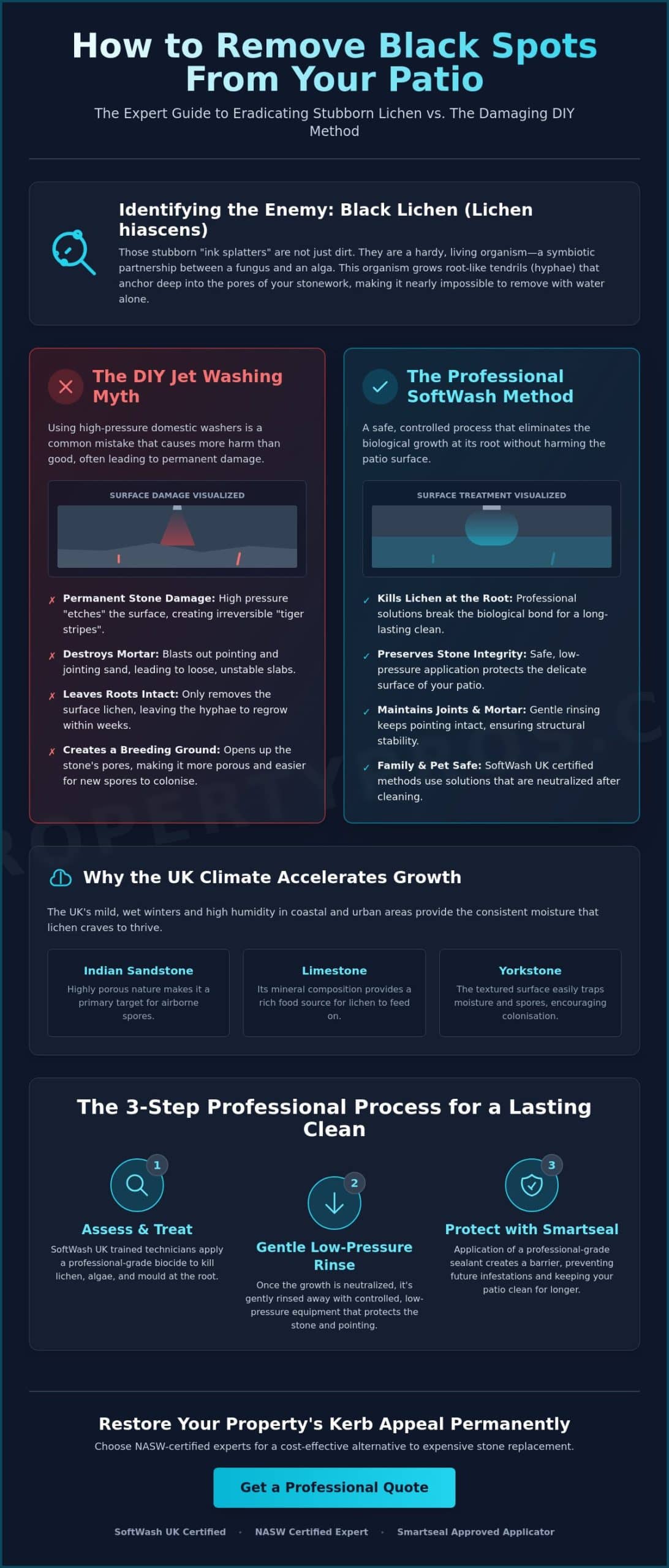
How to Remove Black Spots: The Professional Soft Washing Method
Soft washing is the industry-standard method for biological removal. It’s the most effective way to handle stubborn infestations that regular pressure washing can’t touch. When you’re looking at how to remove black spots from patio surfaces, it’s vital to understand that these spots aren’t just dirt. They are lichen, a complex organism that anchors itself deep into the pores of your stone. Traditional jet washing often only removes the surface layer, leaving the “roots” or hyphae intact to regrow.
Our professionals use Sodium Hypochlorite-based biocides specifically formulated to chemically kill the lichen at its source. A critical part of this process is the “dwell time.” This is the period where the solution remains on the stone to break down the biological matter. Without this dedicated time, the treatment won’t reach the deeper layers of the organism. Professional application is essential. Our technicians ensure the chemical concentrations are exact, providing a deep clean while protecting the integrity of your patio materials.
The 5-Step Professional Removal Process
- Step 1: Surface preparation. We begin by clearing all loose debris, leaves, and furniture. This ensures the biocide makes direct contact with the stone surface.
- Step 2: Application of professional-grade biocide. Our SoftWash UK trained operatives apply the specialist solution using professional equipment. This ensures even coverage and maximum penetration.
- Step 3: Agitation and dwell time. We gently agitate the surface to help the biocide reach into the stone’s texture. We then monitor the dwell time to ensure the lichen is fully neutralised and the black spots begin to disappear.
- Step 4: Low-pressure rinse. Unlike aggressive jet washing, we use a low-pressure rinse to wash away the dead organic matter. This protects your mortar and delicate stone surfaces from damage.
- Step 5: Post-treatment neutralisation. This final step is vital for safety. We apply a neutralising agent to ensure the pH levels are balanced and the area is safe for your family to enjoy immediately.
Safety and Environmental Controls
My Property Pros technicians prioritize the safety of your home’s ecosystem. Before we start, we protect surrounding flower beds and lawns by pre-saturating them with water or using physical barriers. This prevents the biocide from affecting your prized plants. While the RHS guide to removing algae and lichen provides excellent context on how these organisms grow in UK gardens, professional soft washing provides the heavy-duty solution needed for established black spots.
We use specific neutralising agents that make the patio completely safe for pets and children as soon as the job is finished. Our team is fully insured and DBS checked, giving you total peace of mind throughout the process. You can find more technical details about our specialized equipment and chemicals on our Soft Washing Services page. We don’t just clean your patio; we restore it using methods that are safe, controlled, and designed to last.
Regional Considerations for Patio Care in the UK
Understanding your local environment is the first step in mastering how to remove black spots from patio surfaces effectively. In cities like Nottingham and Milton Keynes, local geography and soil drainage often lead to persistent dampness. This moisture provides the perfect breeding ground for Lichen hertelii, the organism responsible for those stubborn black marks. While many homeowners search for how to remove black spots from patio areas using DIY methods, regional factors often make professional intervention necessary to achieve a lasting result.
Coastal properties in Bournemouth or Edinburgh face the added challenge of salt air, which acts as a corrosive agent and can weaken the structure of natural stone. This makes the stone more susceptible to moisture ingress and organic growth. For homes in high-pollution areas like Barnet or Orpington, a “clean and seal” approach is vital. Atmospheric pollutants settle on surfaces, creating a nutrient-rich layer that allows black spots to thrive. Since our 2024 service update, we’ve found that sealing these patios after a deep clean reduces regrowth rates by up to 80% in urban environments.
Local Climate Impacts on Lichen
Rainfall is a primary driver of lichen growth. Patios in Cardiff and Newport face higher moss and lichen pressure because these areas receive over 1,150mm of annual rainfall according to Met Office data. In leafy counties like Hertfordshire or Buckingham, heavy tree canopy cover creates shaded, damp microclimates that accelerate the spread of black spot. Our technicians use specialized equipment to treat these specific conditions safely. To ensure your property receives the right treatment for its environment, you can find a local specialist via our Franchise Locations page.
Stone-Specific Advice
The type of stone you have dictates the cleaning strategy. Indian Sandstone is highly porous, meaning black spots can root deep within the stone. Porcelain is less porous but still suffers from surface spots that require specific chemical concentrations to remove without damaging the finish. Using the wrong pressure or chemical mix can cause permanent scarring to the surface.
My Property Pros technicians are trained to identify stone types before any work begins. We use professional pressure washing equipment, including rotary surface cleaners, to ensure even results without the striping caused by standard jet washers. Every operative is SoftWash UK trained and certified, ensuring that all professional cleaning solutions are controlled and neutralized to be safe for your family and pets. Our status as a UK-wide partner of Smartseal means our team can apply professional-grade sealants that provide a 95% success rate in preventing long-term damage and staining.
Preventing Black Spots: Long-Term Protection with Smartseal
Cleaning your outdoor space is only half the battle. While learning how to remove black spots from patio surfaces restores their immediate beauty, protection is the key to longevity. Without a professional sealant, porous stone remains an open invitation for moisture and organic spores. Those stubborn black lichen spots can begin to return in as little as 12 to 18 months if the surface isn’t properly shielded from the elements. We view cleaning as a restoration process and sealing as an insurance policy for your property.
My Property Pros has established a national partnership with Smartseal, the UK leader in high-performance surface coatings. This partnership allows us to provide professional-grade protection that isn’t available in standard DIY shops. Sealing creates a hydrophobic barrier that repels water and prevents UV rays from fading the natural pigments of your stone. It’s a strategic, cost-effective alternative to the high expense of re-paving or the frustration of frequent deep cleans.
The Benefits of Professional Sealing
Lichen spores are incredibly opportunistic. They “root” deep within the microscopic pores of natural stone and concrete. Professional sealants effectively plug these gaps, creating a smooth, invisible shield that denies spores a foothold. This doesn’t just stop growth; it makes future maintenance significantly faster. You also have control over the final aesthetic of your patio. We offer a range of finishes, including a completely natural look, a subtle matt finish, or a vibrant “wet look” specifically designed for block paving. Our technicians are fully trained Smartseal applicators, ensuring the product is applied with precision for a uniform, long-lasting finish that can last for years.
Maintenance Tips for Homeowners
Once our experts have restored and sealed your surfaces, keeping them in top condition is straightforward. You don’t need specialist equipment to maintain the results between professional visits. Consistent, simple actions make a massive difference in the health of your stone. We recommend a few basic habits for every homeowner:
- Clear debris: Sweep away leaf litter and organic matter weekly to prevent tannins from staining the surface.
- Manage water: Use a stiff brush to move standing water off the patio after heavy rain.
- Gentle cleaning: Avoid aggressive domestic chemicals that can degrade the sealant over time.
By following these steps, you won’t need to worry about how to remove black spots from patio slabs for a very long time. Our goal is to provide you with peace of mind and a property that stays looking its best year-round. If you’re ready to transform and protect your outdoor space, our uniformed, DBS-checked specialists are here to help. Request a professional patio assessment from your local My Property Pros expert to get started.
Protect Your Investment With Professional Patio Restoration
Leaving black lichen to spread across your paving doesn’t just ruin your home’s kerb appeal; it causes permanent surface damage. You’ve learned that high-pressure jet washing often fails to kill the spores, leading to regrowth within weeks. True restoration requires the professional soft washing method, which uses controlled, neutralized solutions to eliminate organic growth at the root. As a UK-wide partner of Smartseal, our technicians apply professional-grade sealants that provide long-term protection against the elements.
Understanding how to remove black spots from patio surfaces effectively means choosing a team with the right credentials. Our operatives are SoftWash UK Trained and Certified, ensuring every job meets the highest safety standards. We provide peace of mind through our fully insured, DBS checked, and uniformed technicians who arrive in sign-written vehicles. Don’t let stubborn lichen devalue your property when a cost-effective professional solution is available.
Restore your patio to its former glory with our professional soft washing services
Your outdoor space deserves the expert care that only a national specialist can provide.
Frequently Asked Questions
Can I use household bleach to remove black spots from my patio?
You shouldn’t use household bleach because it lacks the chemical strength to penetrate the hard calcium shell of lichen. Domestic bleach typically contains 3% to 5% sodium hypochlorite, which is too weak to kill the root system of the organism. Our SoftWash UK trained technicians use professional-grade biocides that are specifically formulated to eradicate the spores. This professional approach ensures the spots don’t return quickly and avoids damaging the structural integrity of your stone.
How long does it take for black spots to return after professional cleaning?
Black spots typically stay away for 2 to 5 years after a professional deep clean and treatment. The exact timeframe depends on your garden’s specific environment, such as the amount of shade and proximity to trees. Because we’re a UK-wide partner of Smartseal, we can apply professional-grade sealants that extend this protection. These sealants create a barrier that makes it much harder for organic growth to re-establish itself in the stone’s pores.
Is the patio black spot remover safe for my lawn and plants?
Our professional cleaning solutions are safe for your garden because our technicians follow strict safety and neutralization protocols. We pre-wet all surrounding grass and plants to protect them before the treatment begins. Once the cleaning is finished, we rinse the area thoroughly to ensure any remaining solution is fully diluted and neutralized. This process gives you peace of mind that your landscaping remains healthy while your patio is restored to its original condition.
Will pressure washing alone get rid of black lichen?
Pressure washing alone won’t remove black lichen because the organism anchors itself deep within the pores of the paving. Using a standard jet washer often results in “striping” or damage to the stone’s surface without actually killing the biological growth. To effectively learn how to remove black spots from patio surfaces, you must use a chemical treatment that dissolves the lichen. We combine these treatments with professional rotary surface cleaners to achieve a uniform, damage-free finish.
How much does it cost to have a patio professionally cleaned in the UK?
Professional patio cleaning in the UK generally costs between £150 and £500 for a standard residential property according to 2024 industry data. Your final price depends on the total square footage, the type of stone, and the level of lichen infestation. We provide clear, fixed quotes after assessing your property. This investment is a cost-effective alternative to expensive repairs, as regular maintenance prevents the long-term degradation of your outdoor surfaces.
Can I remove black spots from Indian Sandstone without damaging the colour?
You can safely remove black spots from Indian Sandstone by using the soft washing method instead of aggressive high pressure. This low-pressure technique uses specialized solutions to break down the lichen while preserving the natural minerals and pigments of the stone. Our experts are trained to handle delicate natural stones, ensuring the vibrant colours are restored rather than stripped away. This professional care maintains the aesthetic value of your property without risking surface delamination.
What is the best time of year to treat patio black spots?
The best time to treat black spots is during the spring or autumn when temperatures consistently stay between 10°C and 20°C. These moderate conditions prevent the cleaning solutions from drying too quickly, allowing them enough contact time to kill the lichen roots. A spring treatment ensures your patio is ready for summer entertaining. An autumn clean removes the organic build-up from the summer, preventing it from becoming a slip hazard during the damp winter months.
Do I need to seal my patio after removing black spots?
We highly recommend sealing your patio because it provides a vital layer of protection against future moisture and spore ingress. As trained Smartseal applicators, we use high-quality sealants that help you maintain the results of your clean for much longer. Sealing makes the surface easier to wash in the future and prevents the stone from becoming porous. It’s the final step in the process of how to remove black spots from patio areas and keep them looking pristine.