
Setting the right price for your window cleaning services can feel like a stressful balancing act. Quote too high, and you risk losing valuable customers. Quote too low, and you’re not just leaving money on the table-you’re threatening the long-term health of your business. We understand this challenge, which is why our team at My Property Pros has created this comprehensive window cleaning pricing guide uk for 2026. It’s designed to remove the guesswork and give you complete confidence in your quotes.
In this guide, we provide a clear, professional breakdown of how to price your services to be both competitive and profitable. We’ll cover everything from the current UK market rates and different pricing models (per window vs. per hour) to accounting for hidden costs like insurance and equipment. By the end, you’ll have a simple, consistent framework to provide quotes that protect your bottom line and help you build a trusted, successful business from day one.
Key Takeaways
- Benchmark your services against typical customer expectations with our complete window cleaning pricing guide UK for 2025.
- Discover the pros and cons of the three main pricing models-per window, per hour, or per job-to find the best fit for your business.
- Learn to calculate your essential running costs, from insurance to fuel, to ensure every job you take on is profitable.
- Master the art of creating a professional written quote that builds trust and helps you win more work from day one.
Understanding UK Market Rates: What Customers Expect to Pay
Understanding what potential customers expect to pay is the first step in building a successful business. This section of our window cleaning pricing guide uk provides a baseline by analysing average market rates. It is crucial to remember these are consumer-facing averages, not rigid rules for your business. As a professional, insured, and reliable service, you are justified in charging more than a casual, cash-in-hand operator. The modern profession has evolved significantly; a general Window cleaning overview reveals the range of tools and safety considerations that justify a professional rate.
Average Residential Window Cleaning Prices
Most residential clients in the UK prefer a regular cleaning schedule, typically every 4, 6, or 8 weeks. Prices reflect this consistency and are usually for an external-only clean. Here are the typical price ranges you can expect customers to see advertised, based on data from leading trade directories.
.price-table { width: 100%; border-collapse: collapse; margin: 20px 0; }
.price-table th, .price-table td { border: 1px solid #dddddd; text-align: left; padding: 8px; }
.price-table th { background-color: #f2f2f2; }
| Property Type | Average Price Range (per clean) |
|---|---|
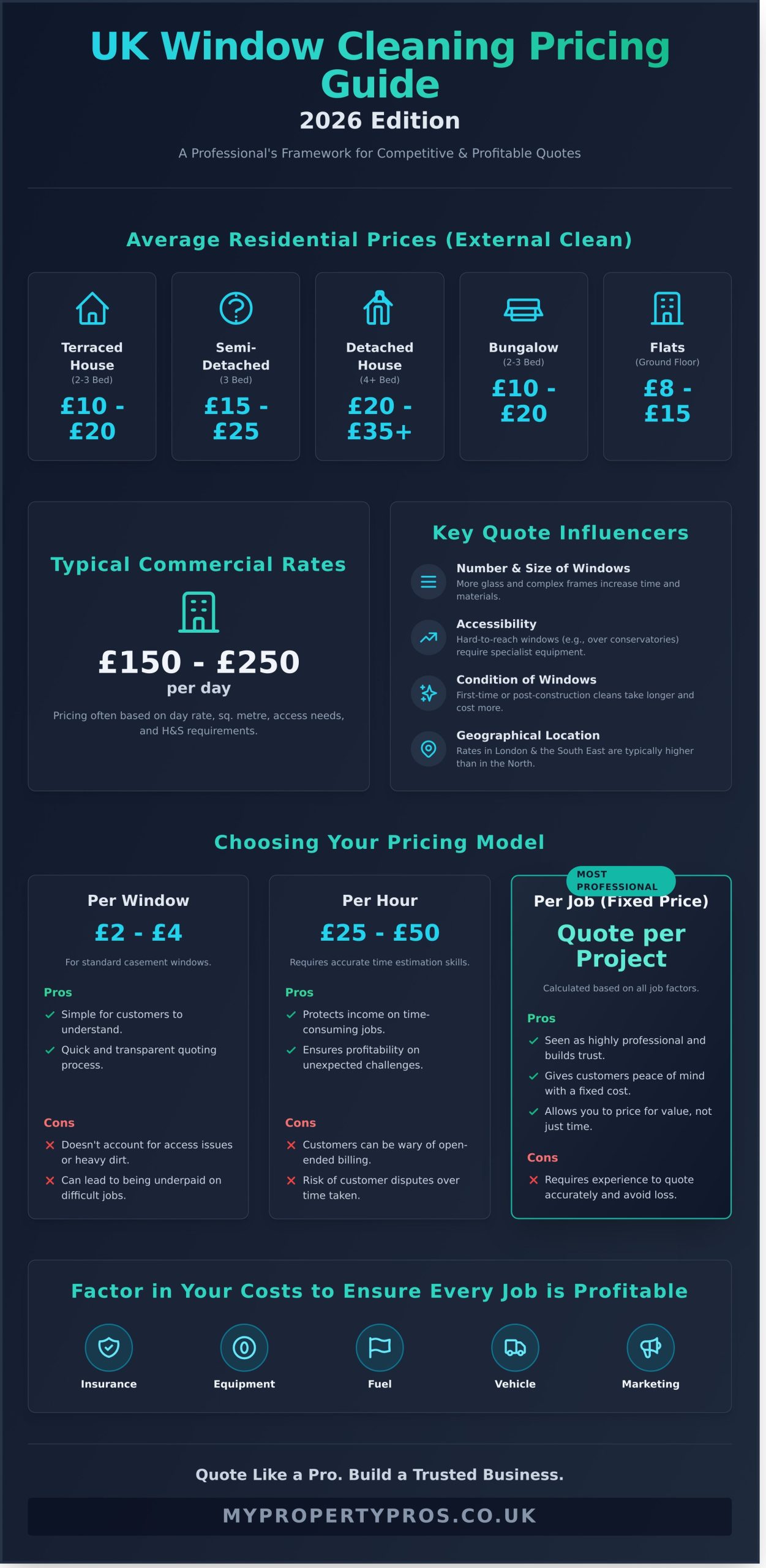
| Terraced House (2-3 bed) | £10 – £20 |
| Semi-Detached House (3 bed) | £15 – £25 |
| Detached House (4+ bed) | £20 – £35+ |
| Bungalow | £10 – £20 |
| Flats (Ground Floor) | £8 – £15 |
Typical Commercial Window Cleaning Rates
Commercial contracts are priced differently due to their scale and specific requirements. Instead of a per-property fee, pricing is often calculated on a day-rate (e.g., £150 – £250 per day) or per square metre. Factors like restricted working hours, specialist access equipment, and detailed health & safety documentation all influence the final quote. While more complex to price, these contracts offer reliable, long-term revenue for your startup.
Key Factors That Influence the Final Price
The averages above are just a starting point. Your final quote for any job, residential or commercial, will be influenced by several critical factors:
- Number and size of windows: This is the most fundamental factor. More glass means more time and materials.
- Accessibility: Windows above conservatories, on third storeys, or set back from the building edge may require specialist water-fed poles or other equipment, increasing the price.
- Condition of windows: A first-time clean or a post-construction clean will take significantly longer than a routine maintenance clean and must be priced higher to account for the extra labour.
- Location: Your geographical area plays a major role. Prices in London and the South East are typically higher than in the North of England or rural areas to reflect the higher cost of living and operating.
Choosing Your Pricing Model: Per Window, Per Hour, or Per Job?
Establishing a clear and consistent pricing structure is one of the most critical steps for your new window cleaning business. The right model builds customer trust and ensures you are paid fairly for your professional work. This section of our window cleaning pricing guide uk explores the three primary methods used by professionals across the country.
The Per-Window Pricing Method
This is the most straightforward approach. You set a standard price per window, typically ranging from £2 to £4 for a standard casement window. You should create a price list for different types, such as charging more for larger sash windows, skylights, or French doors which require more detailed work.
- Pro: This method is simple for you to calculate and easy for customers to understand, making quotes quick and transparent.
- Con: It doesn’t account for access issues, unusually dirty windows, or other complexities, which can lead to you being underpaid on difficult jobs.
The Hourly Rate Method
Charging an hourly rate ensures you are compensated for every minute you spend on a job. A competitive rate for a professional window cleaner in the UK is between £25 and £50 per hour. The key to this model is your ability to accurately estimate how long a job will take before you start.
- Pro: It protects your income on time-consuming or unexpectedly difficult jobs, ensuring profitability.
- Con: Customers can be wary of open-ended billing. They often prefer a fixed price for peace of mind and to avoid surprises.
The Fixed-Price (Per Job) Method
The most professional approach is to provide a single, fixed price for the entire job. This quote is calculated by considering all factors: the number and type of windows, the level of dirt, and any access challenges. It combines the detail of per-window counting with the fairness of time estimation.
- Pro: An upfront, all-inclusive price builds significant trust and positions you as a transparent, professional service provider.
- Con: This method requires experience. New business owners risk under-quoting if they misjudge the time or effort required.
For a new business, we recommend a hybrid approach that leads to a fixed-price quote. Start your calculation using the per-window method to get a baseline figure. Then, adjust that figure based on your estimated time and the job’s difficulty to arrive at a final, fixed price. This provides a reliable quoting system while appearing highly professional. As you gain experience, this process will become second nature, forming a core part of your window cleaning pricing guide uk strategy. Whichever method you choose, consistency is key to building a reputable business and a loyal customer base.
Calculating Your Costs to Ensure Every Job is Profitable
One of the most common mistakes new window cleaning businesses make is basing their prices solely on what competitors charge. While market rates are a useful benchmark, true, sustainable profitability comes from understanding your own numbers first. Failing to cover your costs means you are effectively paying to work.
To build a successful business, you must use a simple, reliable formula: Total Costs + Desired Profit = Your Final Price. This approach ensures every job contributes to your salary and the long-term health of your company. This section of our window cleaning pricing guide uk will show you exactly how to do it.
Step 1: Identify Your Fixed & Variable Costs
Before you can set a price, you need a complete picture of your business expenses. These are split into two categories: fixed costs, which you pay every month regardless of workload, and variable costs, which fluctuate with the number of jobs you complete.
Consider these common overheads:
- Fixed Costs: Public liability insurance, van payments and tax, mobile phone contract, and any software subscriptions for accounting or scheduling.
- Variable Costs: Fuel for your van, cleaning solutions and pure water, equipment wear and tear (poles, cloths, squeegees), and marketing expenses like flyers or online ads.
Keeping a detailed record of these expenses is crucial for financial clarity.
Step 2: Factor in Your Labour and Time
Your time is your most valuable asset, and it must be paid for. As the business owner and primary worker, you need to set a target hourly wage for yourself. A realistic starting point in the UK could be between £15 and £25 per hour. Crucially, remember to factor in travel time to and from each property-this is essential work time that must be included in your job costings.
Step 3: Add Your Desired Profit Margin
Profit is not your wage; it is the money the business earns after all costs, including your salary, have been paid. This surplus is vital for reinvesting in better equipment, funding marketing campaigns, and creating a cash reserve for unexpected issues. A healthy profit margin for a service business is often between 20-30%.
Here is a simple calculation for a sample job:
- Job Costs (Fuel & Supplies): £5.00
- Your Labour (2 hours total, including travel @ £20/hr): £40.00
- Total Direct Costs: £45.00
- Add 25% Profit Margin (£45.00 x 0.25): £11.25
- Final Price to Quote Customer: £56.25
How to Create a Professional Quote and Win the Job
Your pricing is set, but the job isn’t won yet. A professional quote is your most powerful sales tool. It moves you beyond a simple price list and into the realm of a trusted expert. A clear, well-presented quote builds immediate trust, sets you apart from less professional competitors, and demonstrates the value and quality you provide. It is often the deciding factor for a customer choosing your service.
Essential Information to Include in Your Quote
To be taken seriously, your quote must be clear, comprehensive, and easy to understand. It is a direct reflection of the quality of your work. Always provide a written quotation, either on paper or via email, even for smaller residential jobs. Ensure it contains:
- Your Business Details: Your company name, professional logo, address, phone number, and email address.
- A Clear Scope of Work: Specify exactly what is included (e.g., ‘Exterior window glass cleaning for all ground and first-floor windows’) and what is not.
- The Total Price: State the final cost clearly. If you are VAT registered, show the price as ‘£40 + VAT’ to maintain transparency.
- Payment Terms: Outline your accepted payment methods (BACS, card, cash) and when payment is due (e.g., ‘Payment due upon satisfactory completion’).
For inspiration on how to present a professional cleaning service, it can be helpful to look at established businesses. While based in Australia, the website for Maid for Geelong provides a clear example of how a company communicates its range of tailored solutions.
Upselling Services for Increased Revenue
A quote is the perfect opportunity to increase the value of each job without being pushy. Instead of just one price, offer the customer options. This approach empowers them to choose and often leads to higher revenue. Always provide a tiered price that includes cleaning frames, sills, and doors alongside your standard glass-only price.
You can also suggest bundling services for a better value package deal, such as combining window cleaning with a gutter clearing service in the autumn. Mentioning your full range of exterior cleaning services positions you as a complete property care solution. For those looking to expand their offerings, My Property Pros franchisees offer a full suite of services.
Handling Common Customer Questions and Objections
A critical part of any window cleaning pricing guide for the UK is learning to handle price objections. When a potential customer says, “I got a cheaper quote from someone else,” resist the urge to immediately lower your price. Instead, use it as a chance to confidently explain your value.
Highlight that your business is fully insured, giving them complete peace of mind. Explain how your professional, purified water-fed pole system delivers a superior, streak-free finish that lasts longer than traditional methods. Justify your price with reliability, professionalism, and guaranteed customer satisfaction. This turns the conversation from cost to long-term value.
Turn Your Pricing Strategy into a Profitable Reality
Mastering your pricing is the cornerstone of a successful window cleaning business in the UK. By understanding the market, choosing the right pricing model, and accurately calculating your costs, you lay the groundwork for long-term success. This window cleaning pricing guide uk has provided the essential framework to help you quote confidently, win more jobs, and ensure every project is profitable.
Now, it’s time to turn that knowledge into a thriving, professional operation. If you are ready to accelerate your growth and build a business with a trusted reputation, consider the next step in your professional journey. My Property Pros offers the UK’s first and only national exterior cleaning franchise, giving you access to a proven business model, expert support, and professional quoting tools to help you stand out from day one.
Ready to build a profitable business? Learn about the My Property Pros franchise opportunity.
With the right strategy and expert support, your success is within clear view.
Frequently Asked Questions About Window Cleaning Pricing
How much should I charge to clean the windows of a standard 3-bed semi-detached house?
For a standard 3-bed semi-detached house in the UK, a typical price for an exterior-only clean ranges from £15 to £25. This price can vary based on your location, the number and style of windows, and their accessibility. It is always best to assess the property first to provide an accurate and fair quote. This ensures you account for any challenges, such as windows over a conservatory, which may require specialist equipment and additional time to complete safely.
Do I need to register for and charge VAT as a new window cleaning business?
As a new UK business, you are not required to register for or charge Value Added Tax (VAT) until your annual turnover reaches the government-set threshold, which is currently £90,000. Most startups will operate below this level for some time. We strongly advise monitoring your turnover and consulting the official gov.uk website for the most up-to-date information. Operating without charging VAT can be a competitive advantage when you are first establishing your business.
Should I offer a discount for regular customers who sign up for a monthly or bi-monthly service?
Absolutely. Offering a discount for regular, scheduled cleans is an excellent strategy for building a loyal customer base and securing predictable income. A discount of 10-20% off your one-off price is a common incentive for customers committing to a 4, 6, or 8-week cleaning cycle. This approach rewards loyalty, encourages repeat business, and helps you efficiently plan your work schedule, which is vital for growing a successful and sustainable operation.
How should I price interior window cleaning compared to exterior?
Interior window cleaning requires more time and care than exterior work, as you must be cautious around furnishings and flooring. For this reason, it should be priced higher. A common professional practice is to charge 50% to 100% of the exterior price as an additional fee for the interior. For example, if the exterior clean is £20, the interior could be an extra £10 to £20. Alternatively, you could charge a set hourly rate for all internal work.
What is the best way to price conservatory window cleaning, which has many small panes?
Pricing a conservatory per pane is often inefficient due to the high number of small, intricate sections. The professional approach is to quote a fixed price for the entire job. Assess the conservatory’s size, style, and overall condition, paying close attention to the roof. Provide separate prices for cleaning the sides and the roof, as the roof requires more time and specialist equipment. This clear, all-inclusive price is easier for the customer to understand and ensures you are properly compensated.
How do I quote for a first-time clean that is much dirtier than a regular maintenance clean?
A first-time clean almost always involves removing significant build-up of dirt and grime. This requires more time, effort, and cleaning solution, so you must charge accordingly. It is standard industry practice to charge a one-off “first clean” fee, which can be 50% to 100% higher than your standard maintenance price. Clearly explain to the customer that this initial deep clean brings the windows up to a high standard, which subsequent regular visits will then maintain at the lower price.